Here is the link to read, All the Pee in China, Part 1.
This is the blog post I didn’t want to write. The post about how I leaked pee. In public. During our 2019 trip to China. Because a man blocked me from using the restroom.
I knew in advance that this incident would occur. I’d had a Terrible Vision.
The Terrible Vision did not come to me through a dream. I don’t dream—I can’t dream—my overactive MS bladder wakes me, on average, five times a night. I never get a chance to reach a dream-inducing REM state, because I’m too busy jumping in and out of bed.
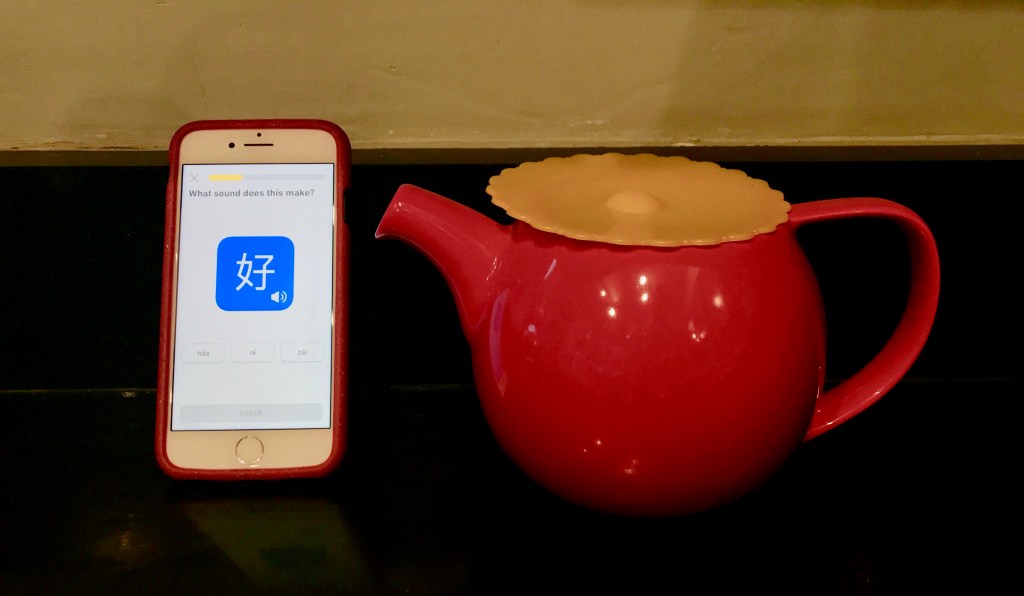
Since my Terrible Vison had no opportunity to reach me through a dream, it reached me through an app. The instant I opened my first Chinese lesson in Duolingo, I was confronted with a word that consisted of two figures: the figure on the left looked to me like a distressed lady crossing her legs because she has to pee, obviously—whereas the figure on the right looked to me like a man standing with his arms outstretched so he could block the lady’s way—to the restroom, obviously.
Those figures together could only mean one thing, right? They had to form the Mandarin word for “bad.”
According to Duolingo, those two figures formed the Mandarin word for “good.”
So much for my intuitive grasp of Chinese.
Our son had warned us that bathrooms would be different in China: some bathrooms had squat toilets, some lacked toilet paper, some were dirty. On those last points, maybe Chinese restrooms wouldn’t be all that different than American public restrooms. My earliest memories of the restrooms at Marconi Beach gave me the useful life skill of always checking for toilet paper before sitting down. Would this life skill be sufficient preparation for the public restrooms in China? I was about to find out. But not before I crossed the hurdle of an all-night flight; as this trip to China was sort of last-minute, we had booked our flights too late to secure the aisle seat necessary for a passenger with my special needs. I projected I would repeatedly rouse all the sleepers in my row.
The one aspect of our impending air travel that I wasn’t worried about was the first leg of our flight, a ninety-minute hop to Toronto. As we boarded that first flight, I reminded myself that no one could tell I was wearing my first ever adult diaper underneath my dress. I’d reinforced my armor with an overnight pad. I was invulnerable! I stowed my sporty messenger bag underneath the seat in front of me. It contained: my wallet, my passport, three additional overnight pads, two spare adult diapers, one spare set of stockings, one spare dress. As I settled next to my husband, I realized we’d finally reached the point where there was nothing left for us to do. The next thing I knew, I was waking from a nap. I felt a little smug about the nap. Do anxious people nap? No, they do not. Do people have to pee after a 90 minute flight? Well, neither did I. Which was lucky, because the fasten-seatbelt lights were blinking. The airplane was already in descent. I must have napped the whole flight to Toronto!
The plane touched down, none too softly. The bumps didn’t make me leak. I was going to get away with this. I was traveling like a normal person. Kind of. Except. I must have packed my special air-travel curse, one I’d perfected in my years of flying monthly to clinical trial appointments at the NIH. Instead of rolling to the gate, the plane just sat. We waited. And waited. It was announced that there were no free gates.
I considered defying the blinking fasten-seatbelt lights, and making my way to the restroom while my bladder was still calm, just to be on the safe side, because my bladder can reach full-on urgency at any moment. But I didn’t want to draw any extra attention to myself if it wasn’t strictly necessary. After all, I’d had the good sense to use the airport bathroom before I’d boarded. Not like my MS bladder follows any rules or cares about my good sense.
Our plane finally started moving. As we rolled to our newly assigned gate, my husband sweetly volunteered to wait around outside for our suitcases, freeing me to spring off the plane and sprint directly to the airport restroom unencumbered. I felt grateful to have such an understanding husband. To make life even easier for me, he volunteered to carry my bulky messenger bag while he waited for our bags. Gentle readers who travel internationally might foresee the flaw in our plan. We did not.
I descended the metal airplane staircase almost like a person who can balance, my fingertips grazing the bannister nonchalantly. The sun came out from beneath a cloud. Which was all it took to kick me out of the realm of the nonchalant. You see, Gentle Reader, MS has messed up my wiring. Overheating, or even the suggestion of overheating, is enough to trigger my MS symptoms. I thought of turning around, of going against the tide of departing passengers who had already been held up, so I could use the airplane restroom. A backward glance confirmed that wasn’t going to happen. I had to go forward, and fast, though not too fast, because…overheating. Most of the passengers stayed behind me by the plane, waiting for their suitcases. I followed the one person ahead of me, a person whose pace made a mockery of my own. Through the glass walls of an empty gate, I could see the sign for the restroom, a little silhouette of a woman in a dress, like me. I could see the restroom door. But the door to the gate itself was locked. Odd. I tried the door the fast passenger had disappeared through. It opened into a hall that ran alongside the empty gate. There was a door to the gate further down the hall. Also locked. Really? This was almost funny. As in, it would be funny later, after I emptied my MS bladder. The perk of having a blog about MS is that every challenge could make an interesting blog post. This post would be hilarious. Right?
Did I say the gate was inaccessible? That was accurate. In fact, the entire terminal was inaccessible, which I learned as I walked down the hall, trying door after door. At one point, I made eye contact with a lone lady with a mop. I crossed my legs. Bounced meaningfully. Rattled the door. She shook her head. We waved goodbye to each other, as I had no choice but to keep walking the hall down the length of the entire terminal. There was a window at the end of the hall. I glanced out over a vast stretch of tarmac to a terminal on the other side. Would I have to walk that far? I’d wondered if my husband was getting worried about me. We’d thought we’d only be separated a few minutes. That was when I felt my first little leak. I took a deep breath. It was going to be OK. More than OK. I’d prepared for this. Why else would I be wearing an overnight pad? Over a diaper. I walked along the twists and turns of the route I was on…chose an escalator over an elevator. Walked some more. Finally came upon a stewardess at the foot of a staircase. I asked where I could find a restroom. I said it was an emergency. I have no pride. She said I was close. I’d just have to go through customs first. She walked me up the stairs, to a uniformed gentleman who resembled Idris Elba. My lucky day? Not.
Gentle readers, I had just met the man of my Terrible Vision. The stand-up man who would block my way to the restroom. And I hadn’t had to travel all the way to China to find him.
The stewardess explained we had…a problem. I explained, I have MS. I have to pee. Now. And Idris Elba explained, we were in an International airport. I would have to go through customs, like every other international traveler. Then I could pee.
Oh.
Customs.
My husband and I had forgotten about that. When he had kindly unburdened me of my messenger bag, he had inadvertently unburdened me of my passport. Which I was going to need. If I was to get to pee. He had also unburdened me of my back-up overnight pads. Which I was also going to be needing, if he didn’t get there soon.
I asked Idris Elba if there was any way the nice stewardess could escort me to some bathroom between the airplane and customs. I had passed plenty on my way.
Idris Elba asked, “Do you want me to lose my job?”
I said, “I do not.”
And sat right down on the airport floor. Because I did not want to pee right there and then. I figured, sitting might help.
It did help.
The passengers from our plane started to arrive. Most of them didn’t cast a glance at my one-person sit-in demonstration against inaccessible airport bathrooms; they might have been in too much of a rush to get to the bathrooms, themselves. I watched them glide their passports across the customs kiosks, then glide through the metal detector. Then disappear. Like that helpful stewardess.
Idris Elba kept looking over. I hoped and hoped and hoped I wasn’t going to be leaving him a puddle.
My husband appeared, his face contorted with worry. It took what felt like forever for him to helpfully dig my passport out of my messenger bag, which was overstuffed with unmentionables. And then it took approximately forever and ever for me to figure out how to use the customs kiosk. Idris Elba finally processed my passport himself. As I passed through the metal detector, I could feel the beginnings of a big leak. The restroom was not as close as I wished it to be. But once I finally got there, I felt so lucky to find a free stall. Lucky. That’s how I felt, as I finally relieved myself. Lucky, as I threw out my first soaked diaper since 1969. As I threw out my underwear. And my stockings. Lucky, as I pulled out a fresh adult diaper, a fresh overnight pad, fresh underwear, fresh stockings.
I was darn near ebullient as I left that restroom. My diaper purchase had paid off! This was a fresh start.
Never have I seen my husband look as somber as he did when I joined him in the posh Toronto terminal. When he finally spoke, he said, “We haven’t even made it to China yet.”
I wish I could have told him then what I can tell you now: I would be throwing out dry diapers and dry overnight pads in Beijing, Nanjing, and Shanghai. I wouldn’t be inconveniencing anybody on our overnight flights.
But I couldn’t know this. And he couldn’t either. That man loves me more than all the pee in China. He is in it for the long haul. Whatever that might be. So we went on. When our son and his partner met us in Beijing, they asked us about our flight. Did we tell them this story? No. We said simply, everything went fine. I was trying to spare my husband’s feelings. He was trying to spare mine.
That was the only moment in the entire trip which truly felt like a defeat.










 Ms Lab Rat